Terrestrial Planet · 0.72 AU from the Sun
Earth's closest planetary neighbor in size and structure — and the hottest world in the Solar System. Beneath brilliant, unbroken clouds lies a crushing, volcanic landscape shaped by a runaway greenhouse effect.
Orbit & Time
Venus completes one trip around the Sun in about 225 Earth days — roughly 62% of an Earth year. It orbits closer to the Sun than Earth does, which means a shorter path to travel and a faster orbital speed, the way anything circling closer to a large gravitational source has to move faster just to stay up. The diagram below shows Venus and Earth orbiting the Sun to scale, moving at their true relative speeds.
Notice how much closer Venus and Earth's paces are compared with Mercury's blistering lap around the Sun. Venus is a far gentler contrast to Earth's orbit — a reminder that "faster" and "slower" in the Solar System is really just a function of how close a planet sits to the Sun's gravity.
Here's one of Venus's strangest quirks: a day on Venus lasts longer than its year. Venus takes about 243 Earth days to rotate once on its axis, but only 225 Earth days to complete a full orbit — so its "day" outlasts its "year." Stranger still, Venus spins backwards. Nearly every planet, including Earth, rotates counterclockwise when viewed from above the Sun's north pole; Venus alone turns the opposite way. Stand on its surface and you'd see the Sun rise in the west and set in the east. Because that reversed spin works against the planet's orbital motion, a true sunrise-to-sunrise day on Venus is "only" about 117 Earth days — still nearly four months, but far shorter than the 243-day sidereal rotation.
Quick Facts
Venus is a planet of contradictions. It's the closest planet to Earth, similar in size and mass, and yet almost nothing about conditions there resembles home. It's the hottest planet in the Solar System despite not being the closest to the Sun. It has a longer day than year. It spins the "wrong" way. And its brilliant appearance in our night sky belies a surface that would crush and cook anything we've ever sent there within a couple of hours. Few planets reward a closer look quite like Venus does.
Temperature & Atmosphere
Mercury orbits, on average, about 58 million kilometres from the Sun. Venus orbits nearly twice as far out, at roughly 108 million kilometres. If distance from the Sun were all that mattered, Venus should be noticeably cooler than Mercury. Instead, Venus is the hottest planet in the Solar System by a wide margin — hot enough to melt lead, at a scorching average of about 467°C, compared with Mercury's daytime peak of 430°C. The reason has almost nothing to do with distance from the Sun, and everything to do with atmosphere.
Venus and Earth likely started out more alike than any other two planets in the Solar System — similar size, similar rock, quite possibly similar amounts of water. But Venus formed close enough to the Sun to receive noticeably more sunlight than Earth. That extra heat evaporated more water into the atmosphere as vapor — and water vapor is itself a powerful greenhouse gas, so more vapor trapped more heat, which evaporated still more water, in a self-reinforcing feedback loop known as a runaway greenhouse effect. Eventually, any oceans Venus once had are thought to have boiled away entirely. High in the atmosphere, sunlight split the water vapor apart; the light hydrogen atoms escaped to space, while the oxygen combined with surface rocks. Without liquid water left to dissolve atmospheric carbon dioxide into rock the way it does on Earth, Venus's CO2 had nowhere to go — and over billions of years, it built up into the crushing, heat-trapping atmosphere we see today.
Just how extreme is Venus's surface? At 467°C, it's hot enough to melt lead (327°C) and zinc (420°C). The atmospheric pressure at the surface is about 93 times Earth's sea-level pressure — equivalent to the crushing pressure roughly 900 metres beneath the ocean's surface here on Earth. No lander has ever survived on Venus's surface for more than about two hours.
The Sky Above
Venus has by far the most massive atmosphere of any rocky planet in the Solar System — about 93 times the mass of Earth's atmosphere, pressing straight down on the surface. Standing on Venus would feel less like standing on a planet and more like standing at the bottom of a deep ocean. No spacecraft has ever survived it for more than a couple of hours.
About 96.5% of Venus's atmosphere is carbon dioxide, with most of the rest nitrogen and only faint traces of other gases. CO2 is a greenhouse gas: it lets visible sunlight pass through freely, but absorbs the infrared heat radiating back up from the surface and re-emits much of it back down instead of letting it escape to space. With this much CO2 stacked 93 atmospheres deep, almost none of the surface's heat can escape — the single biggest reason Venus is hotter than Mercury, despite being roughly twice as far from the Sun.
Venus's brilliant, unbroken cloud deck sits high above the surface, roughly 45 to 70 kilometres up, made not of water droplets like Earth's clouds but of concentrated sulfuric acid. These clouds reflect about 70% of incoming sunlight back into space — more than any other planet — which is exactly why Venus outshines every star and every other planet in Earth's sky. At the cloud tops, winds howl around the planet at over 300 km/h, circling all the way around Venus in just four Earth days — a phenomenon called "super-rotation" that's roughly 60 times faster than the solid planet beneath it rotates, and still not fully explained.
Surface & Geology
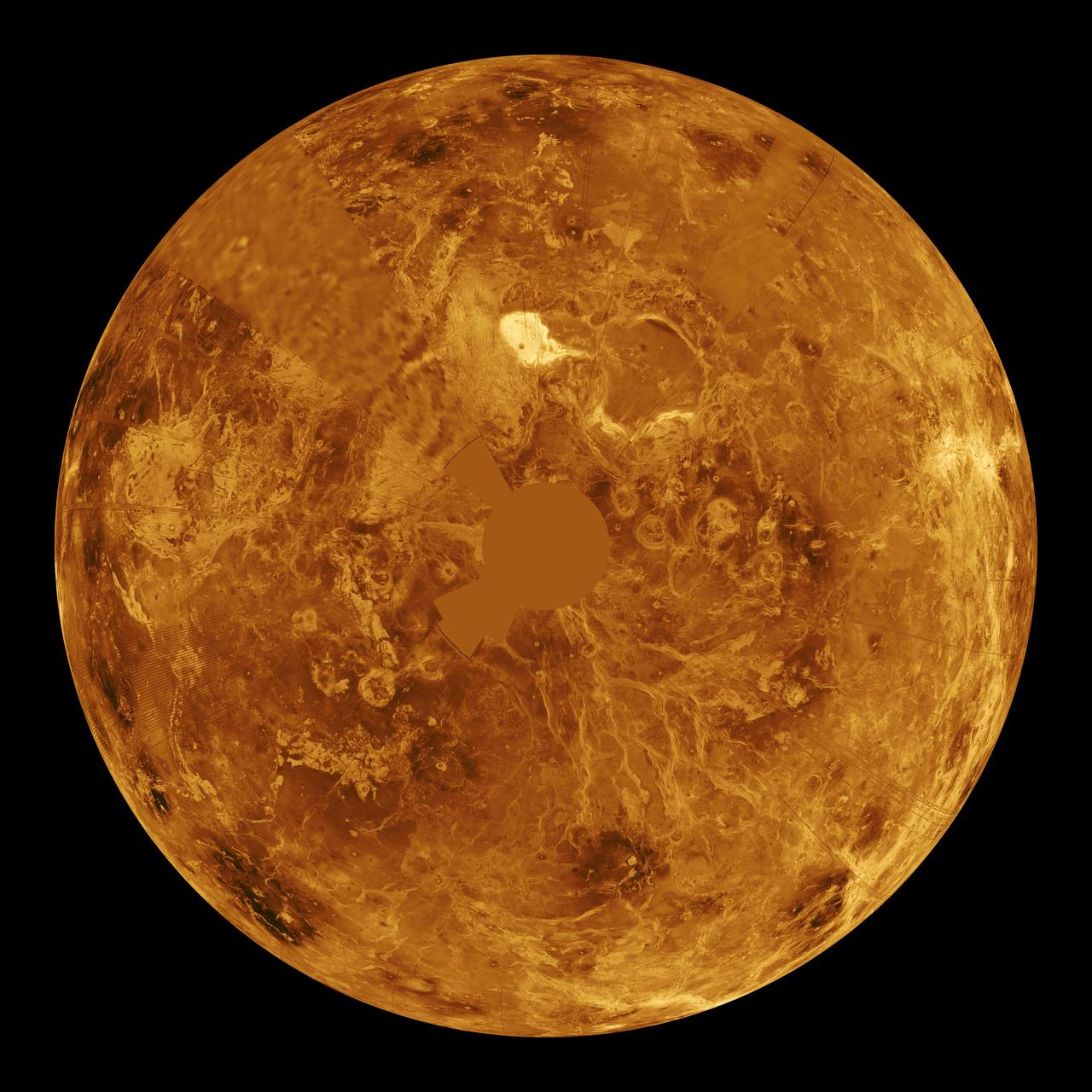
Because Venus's clouds never part, no camera has ever photographed its surface from orbit in visible light. Almost everything we know about Venusian geology comes from radar, which can see straight through the clouds. NASA's Magellan orbiter used exactly this technique in the early 1990s, and the landscape it revealed was stranger than anyone expected: a young, overwhelmingly volcanic world unlike anywhere else in the Solar System.
More than 80% of Venus's surface is covered in smooth volcanic plains, built up by lava flows spreading across the landscape over time. Radar has identified upward of 1,600 major volcanoes and hundreds of thousands of smaller ones — more volcanoes than any other planet, by a wide margin. Some resemble Hawaii's shield volcanoes, scaled up to continent-sized proportions.
Venus isn't just volcanic plains — it also has genuine mountains. Maxwell Montes, in the highland region called Ishtar Terra, rises about 11 kilometres above Venus's average surface elevation, taller than Mount Everest stands above sea level on Earth. It's the highest point on the planet, and one of the few places cool enough — relatively speaking — for an unusual metallic "snow" (likely condensed lead and bismuth compounds) to coat its peaks.
Among Venus's strangest features are coronae — huge, roughly circular structures, sometimes hundreds of kilometres across, found nowhere else in the Solar System. They form where plumes of hot mantle material rise toward the surface, bulge the crust upward, then cool and collapse back down, leaving a ring of fractures and ridges behind. Coronae offer some of the best direct evidence for how Venus moves heat toward its surface without Earth-style plate tectonics.
Perhaps the biggest surprise from Magellan's data was how young Venus's surface looks. Impact craters accumulate at a fairly predictable rate over time, and Venus has remarkably few of them, scattered almost evenly across the whole planet. That pattern suggests the entire surface may have been resurfaced by intense volcanic activity sometime in the last 300 to 500 million years — recent, on a planetary timescale. Whether that happened as one catastrophic global event or through longer, more gradual regional volcanism is still an open question. What isn't in doubt is that Venus may not be finished changing: in 2023, scientists comparing two Magellan radar passes of the volcano Maat Mons, taken eight months apart in 1991, found a vent that had visibly changed shape — the first direct evidence that Venus may still be volcanically active today.
Satellites
Venus has zero natural satellites. That puts it in a small club with just one other member: Mercury. Every other planet in the Solar System has at least one moon, and the outer gas giants have dozens each. Earth, despite being similar in size to Venus, has one of the largest moons relative to its host planet of any in the Solar System. So why did Venus end up with none?
Part of the answer may simply be location. Venus orbits close enough to the Sun that the Sun's own gravity makes it difficult for a moon to hold a stable, wide orbit around Venus over billions of years — beyond a certain distance, the Sun's pull would simply take over and steal the moon away. That leaves only a narrow band of possible stable orbits close to the planet, and it's possible Venus never captured or formed a moon that fit within it.
One especially intriguing hypothesis connects Venus's missing moon to its backwards spin. Some researchers have proposed that Venus once had a moon, formed the same way Earth's Moon was — from debris after a giant early collision — but that a second, later impact reversed the planet's rotation. That reversal would have caused the original moon to slowly spiral inward under tidal forces until it eventually crashed back into the planet, leaving Venus moonless and spinning backwards at the same time. It's a compelling idea, but it remains speculative — any trace of such an ancient impact would likely have been erased long ago by Venus's young, constantly resurfaced ground.
Space Missions
Venus was the target of humanity's very first successful interplanetary mission, and it has drawn spacecraft ever since — though its heat, pressure, and corrosive clouds have made it one of the most punishing places in the Solar System to explore. Nearly everything we know about its surface comes from a small number of missions willing to brave conditions no other planet in the Solar System can match.
Between 1961 and 1985, the Soviet Union launched more than a dozen Venera spacecraft to Venus, racking up a string of planetary firsts. Venera 4 became the first spacecraft to transmit data from within another planet's atmosphere in 1967. Venera 7 achieved the first successful landing on another planet in 1970, surviving just 23 minutes before the heat and pressure destroyed it. Venera 9 returned the first images ever taken from the surface of another planet in 1975. No lander survived longer than about two hours — a testament to just how hostile the Venusian surface really is.
Venus's thick clouds make its surface invisible to ordinary cameras, so NASA's Magellan orbiter used radar instead, bouncing radio waves off the ground and measuring their echoes. Over four years, Magellan mapped about 98% of the surface at resolutions far better than anything before it, revealing a landscape covered in volcanoes, lava plains, and geological features found nowhere else in the Solar System. Magellan remains the primary source for nearly all modern maps of Venus.
Japan's Akatsuki spacecraft studied Venus's atmosphere from orbit for nearly a decade, after an engine failure forced it to circle the Sun for five extra years before a second, successful attempt to enter orbit in December 2015. It tracked the planet's cloud patterns, discovered the largest stationary atmospheric gravity wave ever recorded in the Solar System, and helped explain the physics behind Venus's ferociously fast super-rotating winds. JAXA lost contact with the spacecraft in April 2024 and formally ended the mission in September 2025.
With Akatsuki retired, Venus is temporarily without a dedicated spacecraft — but not for long. NASA's DAVINCI mission will send a probe plunging through the atmosphere to sample its chemistry all the way to the surface, currently targeting a launch around December 2030. NASA's VERITAS and ESA's EnVision will orbit Venus with radar far sharper than Magellan's, mapping the surface in enough detail to search for signs of ongoing volcanic and tectonic activity, with both currently targeting launches in 2031. All three missions have faced funding pressure and schedule changes over the years, but together they represent the first dedicated return to Venus by NASA and ESA in more than three decades.
Bigger Picture
Venus holds a special place in the story of the Solar System. It's the second planet from the Sun, Earth's nearest neighbor, and for most of human history the brightest point of light in the night sky after the Moon — bright enough to cast faint shadows on a clear night, and mistaken by ancient observers for two separate objects: a "morning star" and an "evening star."
Venus and Earth are sometimes called sister planets, and on paper they have a lot in common: similar size, similar mass, similar rocky composition, and likely a similar starting point almost 4.6 billion years ago. But that's where the resemblance ends. One planet developed oceans, a stable climate, and life. The other lost its water, choked on its own atmosphere, and became the hottest place in the Solar System. Understanding exactly where and why these two "sisters" diverged so dramatically is one of the most important open questions in planetary science — not just for Venus, but for what it tells us about the fate of Earth-like planets everywhere, including those now being discovered around other stars.
Every mission to Venus adds a piece to a puzzle that's still far from solved: how does a planet so similar to Earth end up so different? Its runaway greenhouse effect is a real-world case study in climate feedback loops. Its retrograde spin and lack of moons challenge our models of planetary formation. Venus isn't just our nearest neighbor — it's a warning, a mystery, and quite possibly a preview of climates we'd do well to avoid.
Explore the other worlds of our solar system, or launch the interactive Solar System to see Venus's orbit in real time alongside all eight planets. For the full story of how we got here, visit the Solar System Guide.
Sources & Credits
Planetary data via NASA. Global Venus radar mosaic image via NASA/JPL-Caltech.